The Position Was Not Chosen
When every other place is ruled out, the last one decides everything.
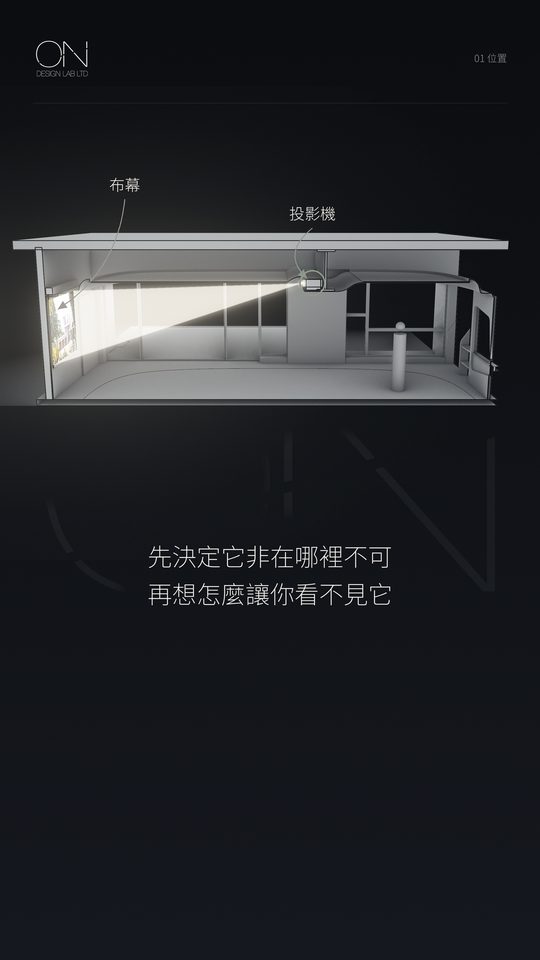
We did not choose where the projector sits. Everywhere else was impossible; this was what remained.
Making It Move Is Easy. Where It Can Stand Is Not.
Hiding a projector in a ceiling is not actually hard. Lifts are off the shelf; so are motorised screens. Buy them, install them, and they drop and retract. The hard part was never making it move. It was where it could stand.
Ruled Out, One by One
The ideal position had sprinkler pipes above it, leaving no depth. Projecting from the dining side instead, the throw was too short and the angle too steep; the light would land on people’s heads. One by one the positions were ruled out until a single one was left, and with it the angle, the height and the distance were all locked. There was no second way to place it.
The One That Remained Could Not Hide It
But that position could not hide it. To tuck it into the ceiling you need a lift. The lift would come down, but it would not go back up unless the ceiling dropped another step. This is a double-height home; the ceiling could not come down. Take that one step back, and everything calculated before it is void. This was a problem we ran into ourselves, on the drawing.
The Projector Stays Still. The Ceiling Opens.
The projector does not lift. It is fixed inside the beam. In front of it is a curved plywood cover that follows the curve of the ceiling and swings upward like a camera shutter. A cover that long will twist if you pull it from one point, so we turned that one point into a whole line.
The lens only shows once the cover has fully opened; the picture can only land once the screen has fully dropped. The three movements take different lengths of time, and one step late the image lands on the cover, or is cut in half. That timing was found during commissioning. The ceiling did not come down by a single centimetre.
How, we keep to ourselves. The section in the film is not an illustration; it is the construction drawing for this project, and the projector position, the throw line and the screen opposite can all be measured off it. The last three photographs are from one camera position: curtains open in daylight, then the ceiling opening and the picture appearing, then the curtains drawn, with no change of lens in between.
"The position was not chosen. It was what was left."
If your home has a beam, a column or something that cannot be removed, and you would rather it became the part worth looking at, bring your floor plan and we will look at it together.