Twenty Thousand Tiles, and No One Picked Them One by One
A painting on a curved bar, and not one tile placed by eye.
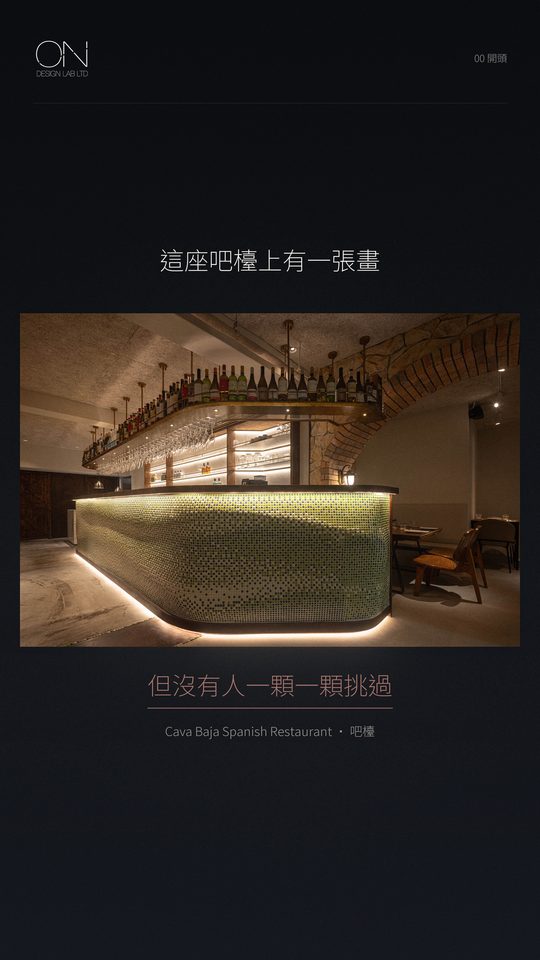
There is a painting on this bar.
Not One Part of This Bar Is Flat
Mosaic comes in flat sheets. On a flat wall or a straight column you simply lay them on; the green tile is a stock item, and the colours are there to choose from. But not one part of this bar is flat.
Unfold It, and It Distorts
To wrap a flat sheet around a curve you first have to unfold the curve, and unfolding always distorts. A tile is also a block with thickness: on a bend, the outer face has further to travel than the back. We measured the whole bar. Across the 7.8 square metres that actually carry tile, 41% of the joints could not be closed, and the worst sheet would have come up nine tiles short. Force it on, and what goes crooked is not the tile. It is the painting.
We found this ourselves, the moment we unfolded the surface.
Painted on the Unfolded Templates
So the surface was unfolded into templates first, and the artist painted straight onto them. The painting was then reduced to four colours, and the computer worked out which colour every single tile should be. The factory pre-laid the sheets to the templates; on site they only had to be matched by number, with the few tightest bends trimmed by hand.
How it is cut and how it is aligned, we keep to ourselves. A hundred years ago, work like this could only be done by a crew picking tiles one at a time and matching colour by eye. This bar, at the Spanish restaurant Cava Baja, is twenty thousand tiles, a hundred sheets, four colours. The heat map and templates in the film were measured from its model; the dot pattern was pressed from the artist’s own sketch.
"The hard part is not the whole bar. It is those few pieces."
A restaurant bar or a curved volume that needs to be wrapped in mosaic: bring the idea for your shop and the site, and we will run the numbers together first.